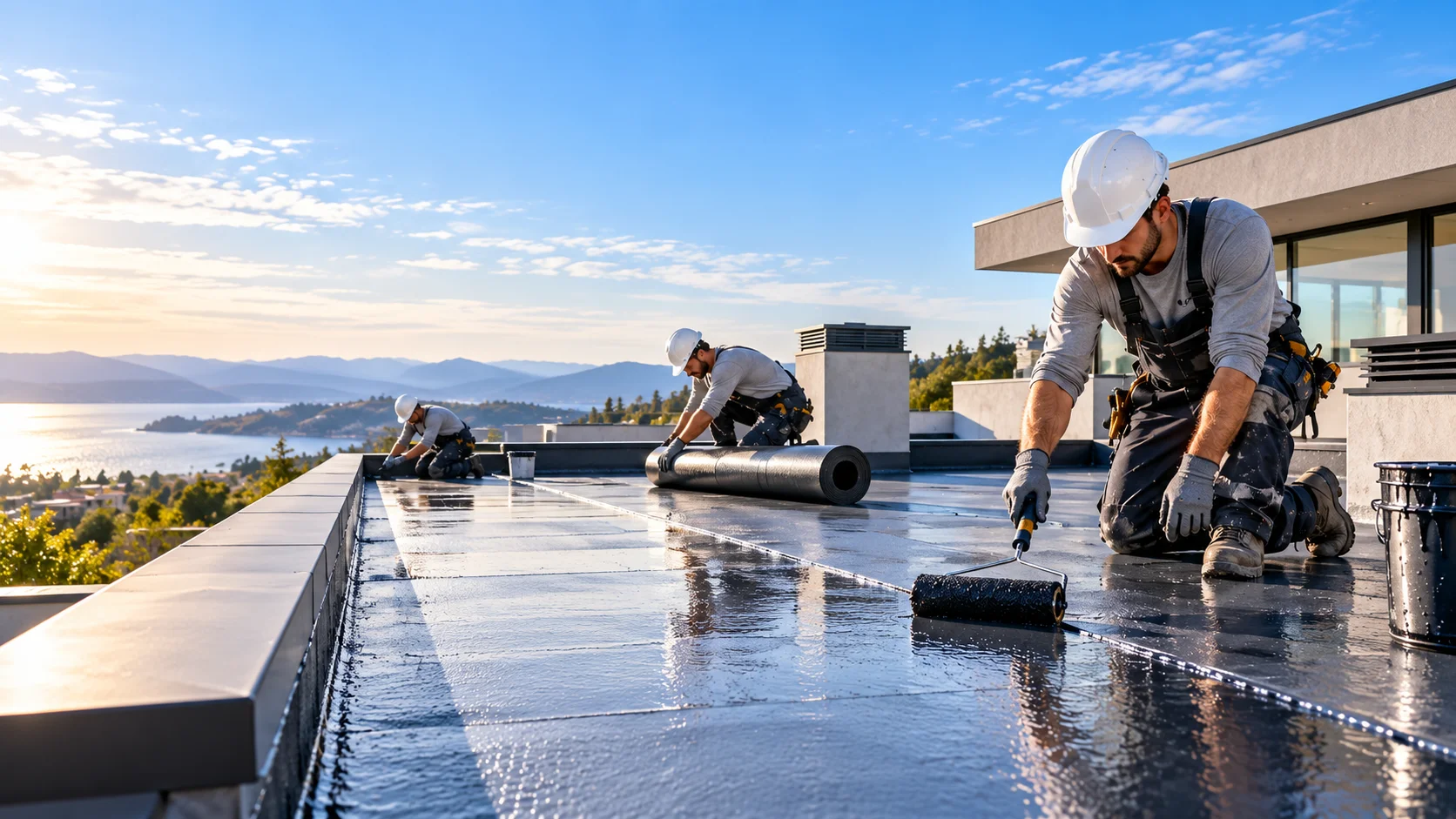
Commercial Waterproofing for Portland Buildings
Parking garages, elevator pits, below-grade walls and multifamily crawl spaces.
Call (971) 772-3963Water intrusion in commercial buildings
A tenant emails a photo of a puddle in the stairwell. Two weeks later it is a second puddle, and now the carpet smells. By the time a building owner hears about water intrusion, it has usually been going on for a season, and the list of consequences is already growing.
Tenant complaints come first. A wet storage room, a flooded elevator pit or a leaking garage ceiling over a parked car all land on the property manager’s desk. Next comes liability: a slick floor, a stained ceiling over a walkway, or damaged tenant inventory that someone will want paid for.
Then the hidden costs arrive. Mold takes hold in shared spaces such as mechanical rooms, corridors and below-grade storage. Drywall and insulation have to be torn out. Rust works into rebar and steel, and concrete that stays wet through the freeze-free but soggy Portland winter keeps losing strength at the surface.
The cause is almost always the same as in a house, just at a larger scale. Rain from October to May saturates clay and silt soil, water builds pressure against below-grade walls and slabs, and it finds every cold joint, crack, sleeve and failed seal. Commercial waterproofing is about finding those paths and shutting them, then giving the water somewhere to go.
Most commercial leaks are not mysterious. They follow the same few paths: construction joints between pours, cracks from settlement or thermal movement, pipe and conduit penetrations, and the floor-to-wall joint where hydrostatic pressure pushes up. Knowing which path you have decides the repair, and it is why the first visit is a walkthrough, not a quote over the phone.
For an HOA board or a building owner, the question is usually how much of the problem is the building and how much is the drainage around it. A failed storm drain, a clogged area drain or a downspout that dumps beside the wall can make a sound building look like a leaking one. We check the site as well as the structure.
Building types we work on
Parking garages
Below-grade and podium garages leak through wall joints, slab cracks and expansion joints. Water drips onto cars, stains the ceiling and pools in drive aisles. We seal active leaks with injection grouting, treat cracks and joints, and add drainage where water collects.
Elevator pits
An elevator pit sits at the lowest point of the building, often below the water table in wet months. Water in the pit puts the elevator out of service and corrodes equipment. We stop the inflow at the wall and floor, and where groundwater is the cause we add a sump and discharge so the pit stays dry.
Retail and office basements
Below-grade retail and office space has finished walls and floors that hide a leak until it becomes a stain. We trace the entry point, repair the wall from the interior where access allows, and install interior drainage along the slab edge to catch what the wall cannot stop.
Apartment and condo crawl spaces
Multifamily crawl space problems add up fast across many units. Damp air rises through floors, insulation sags, and residents complain of odors. A multifamily crawl space gets drainage first, then a sealed liner and humidity control, building by building.
Warehouses
Slab moisture and wall leaks in warehouses damage stored goods and make floors unsafe for forklift traffic. We handle slab moisture control, floor-to-wall joint sealing and drainage around the perimeter.
Methods we use
The method depends on where the water comes from and which side of the wall we can reach.
- Injection grouting. Polyurethane and epoxy are injected into leaking cracks and joints to fill the full thickness of the wall. It works from the interior, which keeps the building in use and avoids excavation.
- Below-grade membranes. When the exterior is accessible, we excavate to the footing and apply a membrane with a protection board and drainage layer. This is the most durable wall fix because it stops water before it touches the concrete.
- Interior drainage. A channel cut along the slab edge collects water that comes through the wall and routes it to a sump. This is the practical choice when the exterior is paved, built over or shared with a neighbor.
- Sump systems. Commercial sumps use larger basins, higher-capacity pumps and, where the building needs it, duplex pumps with alarms so one pump covers for the other.
- Slab moisture control. Coatings, sealers and drainage details reduce water vapor and seepage through the slab, protecting flooring and stored material.
Often the answer is a combination. A garage wall may get injection grouting on the active leaks, a new drain channel along the slab edge, and a sump with an alarm to cover the heaviest storms. Each piece handles a different part of the problem, and together they hold through a full wet season.
Working around tenants
Most commercial jobs happen in occupied buildings. The work has to fit around people, not the other way around.
- Phased work. We split the building into zones so only one area is disrupted at a time, and finish each before moving to the next.
- After-hours scheduling. Noisy or dusty tasks such as concrete cutting can be scheduled for evenings or weekends. Injection work is quiet and often fits during business hours.
- Access kept open. We keep entrances, fire exits, stairwells and accessible routes clear, and we set up barriers and signage around work zones.
- Clear communication. You get a schedule before we start, and the property manager gets one point of contact on site.
For garages and elevator pits, we coordinate with the elevator contractor and any tenants whose parking or access is affected, so no one is surprised by a closed lane or an out-of-service car.
What affects the cost
Commercial waterproofing does not price by a flat rate, and a quote without a visit would be a guess. These are the factors that move the number:
- Building size: the length of wall, the slab area and the number of leak points.
- Access: whether the exterior can be excavated, whether work must happen after hours, and how tight the working space is.
- Below-grade depth: deeper walls mean more excavation, shoring and material.
- System type: injection only, interior drainage and sump, or full exterior membrane.
- Water volume: heavy groundwater calls for larger pumps and more drainage capacity.
For exact pricing on your building, call (971) 772-3963 and book a site walkthrough.
Commercial waterproofing questions
Can you stop a leak without excavating the outside of the building?
Often, yes. Interior injection grouting seals leaking cracks and joints from inside the building, and interior drainage handles water that comes through the wall. Exterior excavation is the better long-term fix when the exterior is accessible and the wall has widespread failure.
How long will a garage or elevator pit be out of service?
It depends on the repair. Targeted injection can often be done in a day or two with limited closures. A pit that needs a new sump and slab work takes longer. We plan the schedule with you and the elevator contractor before starting.
Do you work on multifamily crawl spaces?
Yes. We handle drainage, sealed liners and humidity control for apartment and condo buildings, and we work building by building so residents see minimal disruption.
Can the repair be done while the building is occupied?
Yes. Most of our commercial work happens in occupied buildings. We phase the work, schedule disruptive tasks after hours and keep access routes open.
What should I have ready for the site walkthrough?
Any past repair records, drawings showing below-grade areas, and a list of where and when water appears. Photos from tenants are useful. We will walk the building, find the entry points and give you a scope and price.
Call (971) 772-3963 and schedule a site walkthrough. We will look at the building with you and lay out what the repair involves.
Related repairs
Schedule a site walkthrough
Call to walk the building with us and scope the work.